
AI search · Plain-English guide
AEO vs SEO vs GEO: What’s the Difference, and Which Does Your Business Need?
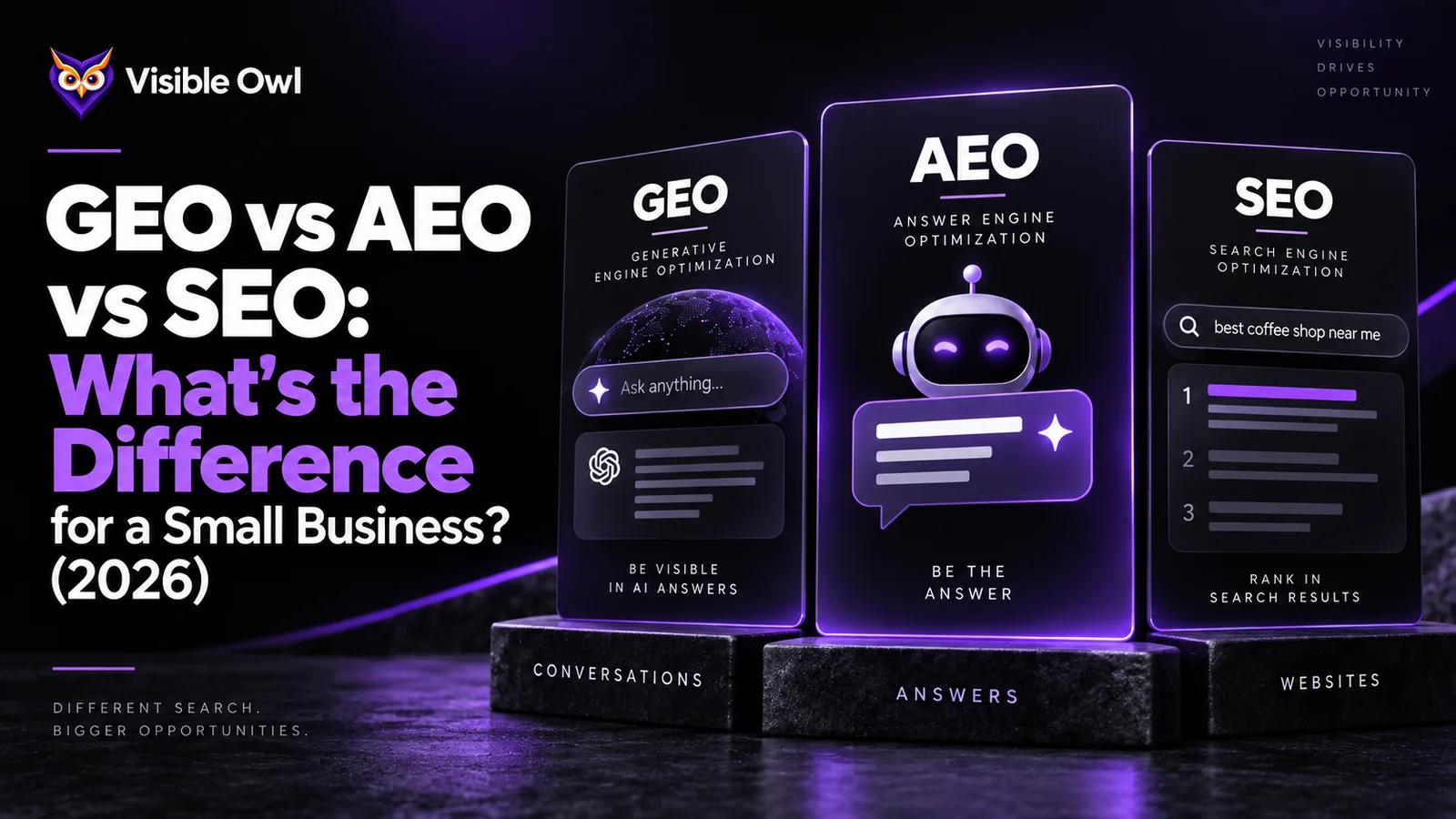
SEO gets your pages ranked in Google. AEO gets your words picked as the direct answer to a question. GEO gets your business named inside the answers AI tools write, like ChatGPT and Google’s AI Overviews. SEO is the foundation. GEO and AEO are their own work on top of it, and most local businesses need all three, run as one plan.
No contract. No exit fee. Your domain and Google accounts stay in your name.

Say you run an HVAC company in Round Rock. Your website shows up on page one for “AC repair Round Rock.” Then a customer asks ChatGPT, “Who can fix my AC today near Round Rock?” It names three other companies. You ranked, but you weren’t picked.
That gap is why new words keep showing up: SEO, AEO, GEO and LLM SEO. They’re related, but they aren’t the same thing. The difference matters when you decide what to work on and what to pay for.
This guide explains each one in plain English. It sticks to what Google has published, to independent research, and to what we found when we searched Central Texas ourselves.
What do SEO, AEO, GEO and LLM SEO mean?
They’re all ways to make a business easier to find. Each one aims at a different kind of result.
| Term | Stands for | The goal | Where it shows up |
|---|---|---|---|
| SEO | Search engine optimization | Rank your pages so people click through to you | Google and Bing results, and the local map |
| AEO | Answer engine optimization | Get your words picked as the direct answer | Featured snippets, People Also Ask, voice assistants and AI answers |
| GEO | Generative engine optimization | Get your business named and cited inside AI answers | ChatGPT, Gemini, Google AI Overviews and AI Mode, Copilot and Perplexity |
| LLM SEO | Large language model SEO | The same goal as GEO, named after the technology | The same places as GEO |
The term GEO comes from a research paper by Pranjal Aggarwal and colleagues, presented at KDD, a major data science conference. It found that some changes, like adding quotes, statistics and sources, raised a page’s visibility in AI answers by up to 40%. What worked changed from one topic to another.
AEO is an older term. People started using it when Google’s featured snippets and voice assistants began reading out one answer to a question.
What’s the difference between GEO, AEO and SEO?
The difference is the result you’re after. SEO wins a click from a list of links. AEO wins the quoted answer. GEO wins a mention inside an answer the AI writes itself.
They share a foundation. But each one needs some work the others don’t, and each one is measured its own way.
| Aspect | SEO | AEO | GEO |
|---|---|---|---|
| What success looks like | A top page that gets the click | Your words chosen as the answer | Your business named in the AI’s answer |
| How people search | Short searches, like “roofer Round Rock” | Questions, like “how much does a new roof cost in Texas?” | Conversations, like “who should I call about hail damage near Round Rock?” |
| What it rewards | Relevance, links, technical health, local signals | A clear question with a direct answer near the top | The same facts everywhere, reviews, mentions and clear pages |
| How you measure it | Rankings, clicks and calls | Featured snippets and answer spots | How often AI tools name you for a fixed set of questions |
AEO vs SEO: what’s the real difference?
Think about one customer question: “How much does it cost to replace a water heater?” SEO is the work that gets your water heater page into the list of results. AEO is the work that gets your sentence picked as the answer at the top, read out by a voice assistant, or quoted by an AI tool.
So SEO wins the click. AEO wins the answer, often before anyone clicks at all. You need SEO first, because an answer engine can only quote a page it can find. Then AEO decides whether your page gets quoted or just listed.
| Question | SEO | AEO |
|---|---|---|
| What are you trying to win? | A spot in the list of results, and the click | The answer itself: a featured snippet, a spoken answer, or a quote in an AI answer |
| What does the page look like? | A full page about one service or topic | The same page, with each question asked plainly and answered in the first two sentences |
| What does Google look at? | Relevance, links, speed and local signals | All of that, plus how clearly one passage answers one question |
| How do you know it’s working? | Rankings, clicks and calls | Answer spots, People Also Ask, and AI tools quoting you |
| Can you do one without the other? | Yes, but you lose the answer spots | Not really. A page has to rank before it gets quoted |
Is GEO replacing SEO? Is SEO dead?
No. Google says its AI answers come from the same search index as its normal results. So the pages that rank are the pages AI can use.
What’s changing is clicks. When an AI summary shows up, fewer people click through to a website. That makes being named inside the answer matter more.
- Pew Research Center found that people clicked a normal search result in 8% of visits when a Google AI summary appeared, and in 15% when none did.
- Bain & Company found that about 80% of search users rely on AI summaries at least 40% of the time, and that about 60% of searches end without a click to another website.
Google also says clicks from pages with AI Overviews tend to be better visits, with people staying longer. For a local business, the lesson is simple. Keep doing SEO, and judge it by calls and booked jobs, not traffic.
What did we see when we searched Central Texas?
We ran 34 Google searches from 11 Central Texas towns, from Round Rock and Austin to Leander and San Marcos, and recorded who showed up. Google showed its map on 27 of them. The typical business in the map had 28 reviews, and every one was rated 4.8 stars or higher.
Half of the regular results were pages written about that exact town. Directories like Yelp took at least 3 of the top 10 spots on 21 of the 34 searches. And Google opened about a third of all our searches with an AI answer.
That’s GEO and AEO in real life. Clear pages about your town, real reviews and complete listings are what both Google and its AI answers pick up. The full numbers are in our Central Texas local search study.
What changes in the work for AEO and GEO?
The technical and local SEO work stays. On top of it, three things change: how you write, where your business shows up, and how you check the results.
- Ask the question, then answer it in the first two sentences. That one habit covers most of AEO.
- State the facts plainly: prices or price ranges, service areas, licenses and years in business.
- Use the same name, address, phone and hours everywhere: your site, Google Business Profile, Bing Places, Yelp and your trade’s directories.
- Earn reviews and real mentions from local news, chambers, suppliers and associations.
- Let search crawlers read your site, including OpenAI’s OAI-SearchBot and PerplexityBot, and keep your structured data matching the page.
- Test the AI answers every month with the same questions, and write down who gets named.
For the step-by-step version, with a free test you can run on your own business, read how to get ChatGPT and Google’s AI to recommend your business.
Does a small local business need GEO, AEO or just SEO?
Usually all three, in the right order. Start with local SEO. Write every page in an AEO style from day one. Then work on GEO: matching listings, steady reviews, local mentions, and checking what AI says about you.
| Where you are now | Focus first | Then |
|---|---|---|
| New website, few reviews | Local SEO basics: Business Profile, one page per service, reviews | Add question-and-answer sections as pages go live |
| Ranking locally, but AI tools don’t name you | GEO: Bing Places, directories, local mentions | Keep the SEO work steady |
| Customers keep asking the same “how much” and “how long” questions | AEO: answer them on the matching service pages | Link each answer to the service it belongs to |
| AI answers show wrong details about you | Fix every listing at the source | Update your own pages to match |

Does GEO or AEO cost more than SEO?
It shouldn’t be three bills. The work overlaps, so it belongs in one plan. But GEO and AEO do add real work: page rewrites, listing clean-up, a review program and testing the AI answers every month. That’s the work worth paying for.
Our prices are published. AI search optimization is part of our Lead plan, starting at $1,495 a month, month to month. Our smaller plans cover the SEO foundation that AI answers depend on.
See what AI SEO, GEO and AEO cost, and every plan on our pricing page.

How do you know if GEO or AEO is working?
Track what pays the bills first: calls, form leads and booked jobs. Then test the same customer questions in the main AI tools every month, so you see a trend instead of one lucky answer.
- Calls and leads by source, including calls from your Google Business Profile.
- Search Console’s Performance report. Google says it includes sites shown in AI Overviews and AI Mode.
- A monthly AI answer test: the same questions in ChatGPT, Gemini, Google’s AI Overviews and AI Mode, Perplexity and Copilot. Write down who gets named and which sources are cited.
- Featured snippets and People Also Ask spots for the questions your pages answer.
What should a small business do next?
Check the basics before you buy anything new. These five steps take an afternoon.
- Search your main service and town on Google, and note where you show up.
- Ask ChatGPT, Gemini, Google AI Mode and Copilot the same question, and note who gets named.
- Compare your Google Business Profile, Bing Places and website details line by line.
- Rewrite your top three service pages to answer the customer’s question first.
- Ask your last ten happy customers for a review.
Questions owners ask about GEO, AEO and SEO
Is AEO better than SEO?
Neither is better. AEO sits on top of SEO. A page has to be found before it can be picked as the answer, so start with SEO, then write each page so its answers are easy to quote.
Is GEO better than SEO?
Neither is better. SEO gets you ranked and clicked. GEO gets you named in AI answers. GEO depends on SEO, because AI tools pull from pages that search engines can find and trust.
What’s the difference between AEO and GEO?
AEO aims to make your words the direct answer to a question. GEO aims to get your business named inside an answer an AI writes. They overlap a lot, so most businesses work on both at once.
Is GEO the same as LLM SEO?
Yes, in practice. Both aim to get a business named and cited in answers from AI tools built on large language models. GEO is the name from the research paper. LLM SEO is a label some agencies use for the same work.
Is AEO just featured snippets?
It started there. Now it covers any place a single answer is pulled from your content: featured snippets, People Also Ask, voice assistants and the answers inside AI tools. The habit is the same: ask the question plainly and answer it right away.
Is SEO dead now that AI answers exist?
No. Google says its AI features use its search index and need no special optimization, so SEO is still how you become a source worth citing. Clicks are shifting, so measure calls and leads, not just traffic.
Do I need an llms.txt file for GEO?
Not for Google. Google says no special AI text files are needed to appear in AI Overviews or AI Mode. Clear pages, crawler access and the same business details everywhere matter far more.
Can a small business do GEO and AEO itself?
Much of it, yes: answer customer questions clearly on your pages, keep your listings the same everywhere and ask for reviews. Help makes sense when wrong details keep coming back, crawlers are blocked, or no AI tool names you after the basics are done.
How long does GEO take to show results?
There’s no fixed timeline. Fixed listings tend to show first, once each AI tool picks up the change. Reviews, mentions and reputation build over months. Test the same questions every month so you can see the trend.
Abdullah Mahdi
Founder of Visible Owl. Leads SEO, AI search (GEO and AEO) and website development, and has built and ranked websites for small businesses since 2015.
Sources
- Aggarwal et al.: GEO, Generative Engine Optimization (arXiv, KDD)
- Google Search Central: AI features and your website
- Google Search Central Blog: Top ways to ensure your content performs well in Google’s AI experiences
- Pew Research Center: Google users are less likely to click on links when an AI summary appears
- Bain & Company: Consumer reliance on AI search results signals new era of marketing
- Visible Owl: Central Texas local search study
Want more answers like this?
Add Visible Owl as a preferred source on Google, and our articles show up more often in your Top Stories and AI answers.
Button not showing? Add Visible Owl on Google.