
AI search · Local business guide
How to Get ChatGPT and Google’s AI to Recommend Your Business
ChatGPT and other AI tools recommend businesses they can find, check and trust. So let their crawlers read your website. Keep your Google and Bing listings complete and the same everywhere. Keep honest reviews coming, give each service its own clear page, and get mentioned on local websites. Nobody can sell you a spot in the answer, but you can test where you stand in about ten minutes.
No contract. No exit fee. Your domain and Google accounts stay in your name.

Picture water dripping through a ceiling in Round Rock. The homeowner doesn’t scroll through Google. They open ChatGPT and type, “Who’s a good roofer near me who can come this week?” It names three companies. If yours isn’t one of them, you never knew they were looking.
This is already normal. BrightLocal found that 45% of consumers now use ChatGPT and other AI tools for local recommendations, up from 6% a year earlier.
The good news is that AI tools don’t pick at random. They repeat what they can find and check about you online. This guide shows how they choose, how to test where you stand, and the seven fixes that matter most. We stick to what OpenAI, Google, Microsoft and Perplexity have published, plus what we learned on our own website.
How do I get ChatGPT to recommend my business?
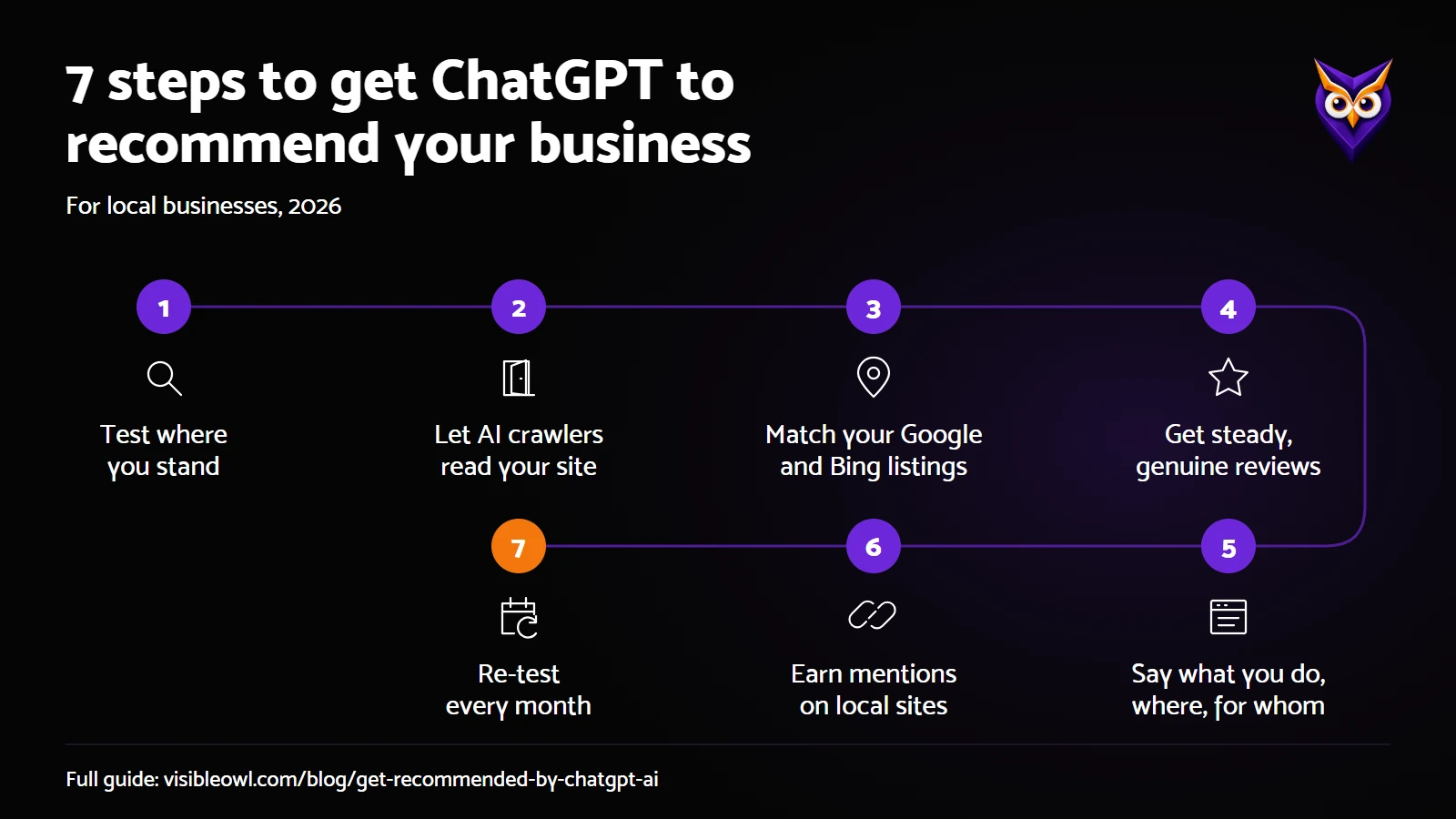
Follow these seven steps, in this order. The first ones pay off fastest. Each step links to the details below.
- Test where you stand. Ask ChatGPT, Gemini, Copilot and Perplexity what your customers would ask, and write down who gets named. Use the free check.
- Let AI crawlers read your site. Make sure nothing blocks OAI-SearchBot, PerplexityBot, Bingbot or Googlebot. How to check.
- Match your Google and Bing listings. Use the same name, address, phone, hours and services on both. Which listings matter.
- Get steady, genuine reviews on Google and at least one other site. How reviews help.
- Say what you do, where, and for whom, with one page for each main service. What to write.
- Earn mentions on local sites, like your chamber, local news and real “best of” lists. Where to show up.
- Re-test every month with the same questions, and fix anything wrong. What to look for.
How does ChatGPT choose which businesses to recommend?
There’s no secret list. When someone asks for a local business, the AI tool searches the web, reads what it finds about businesses nearby, and sums it up in a few lines. Google says its AI can run several searches for one question, and it only links to pages it has indexed.
Each tool looks in slightly different places. That’s why one tool can name you while another leaves you out.
| AI tool | Where it looks |
|---|---|
| ChatGPT | Web search through outside search partners. If you share your location, it also uses local listings from trusted third-party providers. |
| Gemini | Google Maps. Google says Gemini uses public Google Maps information for addresses, websites, ratings and opening hours. |
| Google AI Overviews and AI Mode | Google Search, including your Google Business Profile. |
| Microsoft Copilot | Bing search and Bing Places, Microsoft’s business listing. |
| Perplexity | Its own search index, built by its crawler, PerplexityBot. |
You can already see this on Google. For our Central Texas local search study, we searched Google from 11 towns. Google opened 14 of 45 searches with an AI answer, and it did for every “google ads” search in Central Texas.
How do I check if ChatGPT recommends my business?
Ask the AI tools what your customers would ask, in the words they would use. Use a private or logged-out window if you can, so your own history doesn’t change the answer. Ask each question two or three times, because the answers change from one try to the next.
Here are questions a roofer in Round Rock might test. Swap in your own trade and town:
- “Who’s the best roofer in Round Rock?”
- “Who can fix a roof leak in Round Rock this week?”
- “Which roofers near Round Rock have the best reviews?”
- “Is [your business name] a good roofer?”
For each answer, write down three things: whether you were named, who was named instead, and which websites the tool linked to. Those websites matter most. They help explain why someone else got picked, and they show you where you need to show up. The free tool below writes the questions for you and keeps score.
Free tool · about 10 minutes
Does AI recommend your business?
Pick your trade and town. We’ll give you the questions customers actually ask, you run them in each AI tool, then record who got named. Nothing you enter here is sent anywhere.
Step 2 · run the prompts
Ask these in each AI tool
Use a private or logged-out window where you can, so past chats don’t steer the answer. Ask each question as written, and note which businesses get named and which sites the answer cites.
Your AI recommendation snapshot
0 of 0 tools named you
A snapshot, not a verdict: AI answers change between runs and between people. Test again in a month, after you’ve made changes.
Want us to run the full check for you?
Leave your details in any of the forms on this page and we’ll test more questions, record the sources each tool cites, and tell you what to fix first. Or call us.
Call Visible Owl · (512) 553-9675Can ChatGPT and other AI tools read my website?
Only if your website lets their crawlers in. A crawler is the robot a company sends out to read web pages. Your robots.txt file, at yourdomain.com/robots.txt, tells each crawler whether it’s welcome.
These are the crawlers that matter for AI answers:
- OAI-SearchBot puts your site in ChatGPT search. OpenAI says to allow it if you want to show up there.
- GPTBot collects pages to train OpenAI’s models. It’s separate from search, so blocking it won’t hide you from ChatGPT search.
- PerplexityBot builds Perplexity’s search results.
- Bingbot feeds Bing, which Microsoft Copilot runs on.
- Googlebot feeds Google Search, AI Overviews and AI Mode.
We learned on our own website that robots.txt isn’t the only gate. Ours welcomed every AI crawler. But when we tested each one, our web host’s security layer was still turning GPTBot away. ChatGPT’s search crawler got through fine. Our host also kept showing crawlers an old copy of robots.txt until we cleared its cache.
So don’t stop at reading the file. Ask ChatGPT to open one of your pages and sum it up. If it can’t, something is in the way. Then ask your web developer or host to test each crawler above. Each one should get your real page, with no error and no “prove you’re human” screen.
Which business listings do ChatGPT, Gemini and Copilot use?
Start with the two big ones. Your Google Business Profile feeds Google’s AI answers and Google Maps, and Google says Gemini finds places through Google Maps. Bing Places is Microsoft’s version, and Microsoft says it plans to tie Bing Places more closely to Copilot.
ChatGPT is harder to pin down. OpenAI doesn’t say which listing providers it uses. Local Falcon, a local search software company, looked into it. It reported that ChatGPT has no direct link to Google Business Profile. Instead, it said, ChatGPT draws on sources like Bing Places, Yelp, the Better Business Bureau, chamber of commerce sites and local news. Treat that as an educated guess from outside OpenAI.
- Google Business Profile: categories, services, service area, hours, photos, and replies to reviews.
- Bing Places: the same name, hours, phone and website link as on Google.
- Yelp and the BBB: claim both listings and copy your details exactly.
- Your chamber of commerce or trade group: a member page with your services and a link to your site.
Whatever you list, make it match everywhere, down to the phone number and the way you write your business name. AI tools trust facts they can confirm in more than one place.

Do reviews help AI recommend my business?
Yes. Google says the number of reviews and your rating help decide how prominent you are in local results. The words in reviews help too. When a customer writes “they fixed our AC the same day in Pflugerville,” an AI tool has real words to repeat.
How many do you need? In our Central Texas local search study, the typical business in Google’s map had 28 reviews. Every business in the map was rated 4.8 stars or higher.
- Ask every customer when the job is done, and send a direct link to your Google review form.
- Never buy reviews or tell people what to write. It breaks Google’s rules, and Google removes those reviews.
- Reply to every review, good and bad. It shows people, and AI tools, that you’re real and paying attention.
- Collect a few reviews on other sites too, like Yelp or your BBB listing, because ChatGPT and Copilot don’t read Google the way Google does.
For the full routine, including where to find your review link and what to say, see how to get more Google reviews.

What should my website say so AI tools recommend me?
It should tell a customer, or an AI tool, everything they need to feel sure about you. That means what you do, where you do it, who it’s for, roughly what it costs, and proof you’re real.
This matters more every month. Google’s AI Mode can already check prices and availability for some local services, and it can even call businesses for the searcher. The more you publish, the less it has to guess.
- One page for each main service. Twenty services crammed into one paragraph gives an AI tool nothing clear to quote.
- Your service area in plain words, like “We serve Round Rock, Georgetown, Hutto and Pflugerville.” Never invent an office in a town where you don’t have one.
- Price ranges, or what changes the price, so an AI answer about cost has something honest to repeat.
- Licenses, insurance and years in business, where people can see them.
- Real questions with direct answers, in your customers’ words, like “Do you do same-day AC repair in Cedar Park?”
- The same name, phone and address as your listings, written as text. A phone number inside a picture is harder for search tools to read.
Structured data is code that labels your business details for search engines. It helps when it matches what’s on the page, but Google says it isn’t required for its AI features. If your site can’t do the basics above, a site built to be read by search engines and AI tools is the bigger win.

Does it help to be mentioned on other websites?
It helps a lot. AI answers are built from sources, and a business that other websites talk about is easier to trust than one that only talks about itself. Local mentions count most:
- Your chamber of commerce, like the Round Rock Chamber, with a full member profile and a link to your site.
- Local news, for something worth covering: a community project, storm clean-up help, a new hire. Community Impact and neighborhood sites cover local businesses.
- Sponsorships you really care about, like youth sports or a school event, where the sponsor page names you.
- Suppliers and partners who list you as a certified installer or preferred contractor.
- Town directories and genuine “best of” lists. Skip lists that only exist to sell spots, and anyone promising a guaranteed place in AI answers.
What if ChatGPT gets my details wrong or names a competitor?
It happens a lot, and it’s usually fixable. Wrong details almost always trace back to an old listing, a directory nobody updated, or a page on your own site. Here’s where to start:
| What you see | Likely cause | First fix |
|---|---|---|
| You’re not named at all | Thin listings, or no page for that service | Finish your Google and Bing listings, and add a service page |
| A competitor is named instead | More reviews, more listings or a clearer page | Open the websites the answer linked to, and close the gaps |
| An old phone number or business name | An outdated directory listing | Claim and update the listing the answer used |
| Wrong hours, or “may be closed” | Hours differ between Google, Bing and your site | Make your hours match everywhere, holidays too |
| A service you don’t offer | Vague wording on your site | Say clearly what you do and don’t do |
If you’ve renamed your business, watch the old name closely. We know this one firsthand: Visible Owl used to be La Jolla Media Solutions, and old listings don’t update themselves.
How long does it take, and can anyone guarantee it?
Nobody can guarantee it. Google says there are no special tricks needed for its AI features, and you can’t buy a spot inside the answer the way you buy an ad. Be careful with anyone who promises you’ll be “the answer” in ChatGPT by a set date.
Some fixes show up fast. Unblocking a crawler or fixing a listing can show within weeks, once the tools search again. Reviews and mentions build over months.
So measure it the same way every month. Ask the same questions in the same tools, and keep a simple score:
- How many questions named you, out of the total
- Which competitors were named instead
- Which websites the answers linked to
- Any wrong details, and whether last month’s are fixed
Should I do this myself or get help?
You can do most of it yourself: claim your listings, ask for reviews, and give each service a clear page. Get help when your site blocks crawlers, when wrong details keep coming back, or when you’re still not named after the basics are done.
If you’d rather have it measured for you, our free AI visibility audit shows who AI recommends in your place, and why. Our AI SEO work then fixes it, month to month. To learn the jargon first, read GEO vs AEO vs SEO explained. Or just call (512) 553-9675.

Quick answers about AI recommendations
Can I pay to be recommended by ChatGPT?
Not inside the answer. Where an AI tool sells ads, they’re labeled and kept apart from the answer. What you can do is make your business easy to find, check and trust, which is what this guide covers.
Should I block AI bots from my website?
Block training if you want to, but keep search open. OpenAI’s GPTBot collects pages for training, while OAI-SearchBot is what puts sites in ChatGPT search. PerplexityBot builds Perplexity’s results. Blocking the search crawlers can keep you out of those answers.
Why does ChatGPT give a different answer every time?
AI answers aren’t a fixed ranking. They change with the wording, the person’s location, their past chats and each new search the tool runs. That’s why the useful measure is how often you’re named across several questions, tested the same way every month.
Does my Google Business Profile help with ChatGPT?
It matters most for Google’s own AI answers and for Gemini, which finds places through Google Maps. OpenAI doesn’t say where ChatGPT gets its listings, and outside research points to Bing Places, Yelp and the BBB. Keep the same details everywhere, so every tool finds the same facts.
Is getting recommended by AI different from local SEO?
It’s the same foundation with a wider net. Local SEO focuses on Google’s map and your Business Profile. AI answers also pull from Bing, other review sites, directories and pages that answer questions clearly. Our local SEO guide for Austin and Round Rock covers the map side.
Abdullah Mahdi
Founder of Visible Owl. Leads SEO, AI search (GEO and AEO) and website development, and has built and ranked websites for small businesses since 2015.
Sources
- Google Search Central: AI features and your website
- Gemini Apps Help: Find places and get directions in Gemini Apps
- OpenAI: Overview of OpenAI crawlers (OAI-SearchBot, GPTBot)
- OpenAI Help Center: Searching the web with ChatGPT
- Perplexity: PerplexityBot and Perplexity-User
- Microsoft Bing Blog: Introducing the new Bing Places for Business
- Google: New AI features in Search, including calling businesses for pricing and availability
- Google Search Help: Use AI Mode to check local availability and pricing
- Google Business Profile Help: Tips to improve your local ranking
- Google Maps: User contributed content policy (fake engagement)
- BrightLocal: Local Consumer Review Survey
- Local Falcon: ChatGPT local search data sources
Want more answers like this?
Add Visible Owl as a preferred source on Google, and our articles show up more often in your Top Stories and AI answers.
Button not showing? Add Visible Owl on Google.