
Google Ads · Lessons from Texas accounts
Google Ads for Texas Home Service and Local Businesses: What We’ve Learned
The lessons that matter most aren’t about clever keywords. They’re about when customers call, whether someone answers, how you count a lead, and how Texas heat, freezes, hail and fast growth move demand. Here is what we’ve learned working with local businesses since 2015, the public data that backs it up, and what to check in your own account.
No contract. No exit fee. Your domain and Google accounts stay in your name.

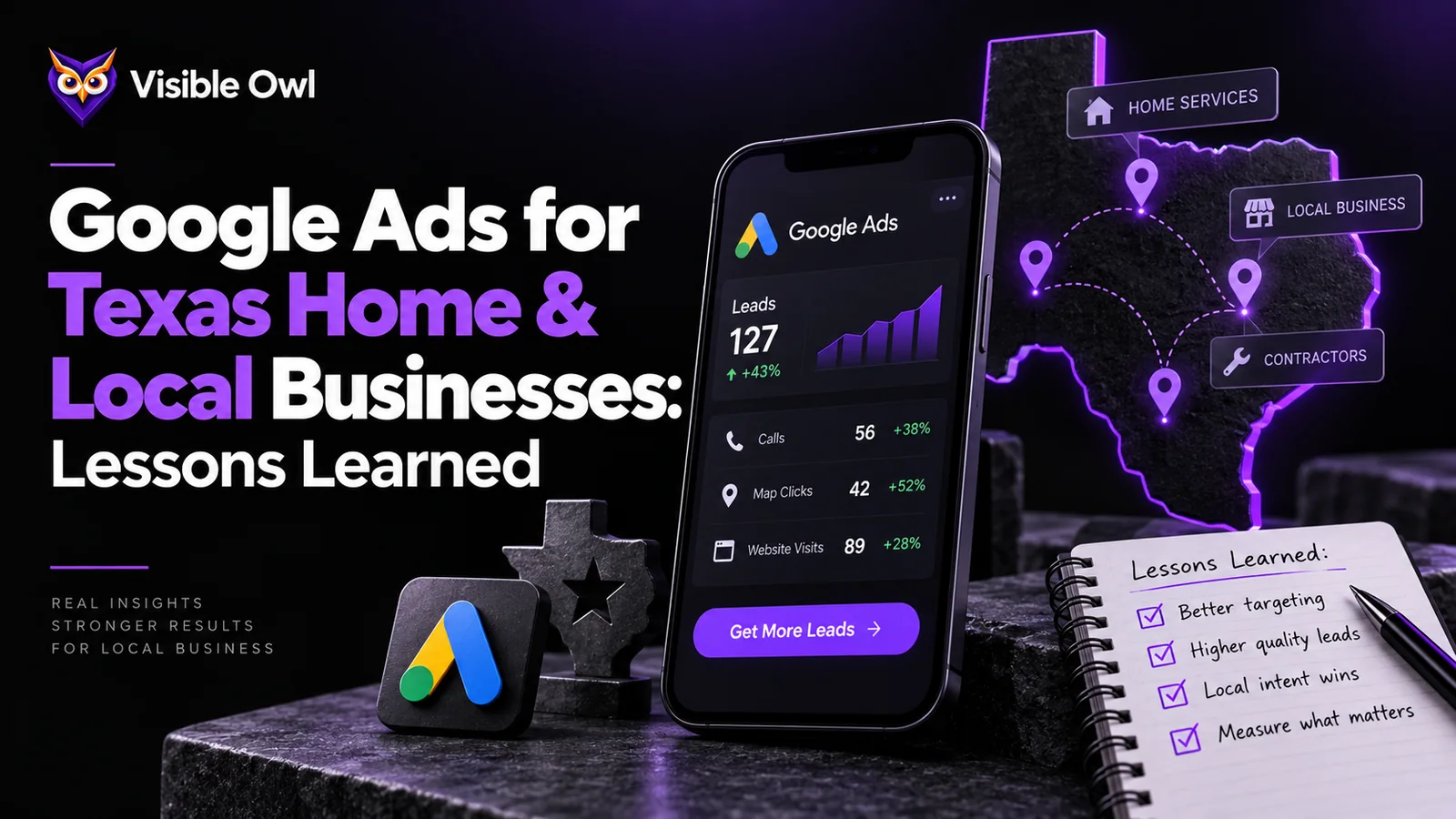
It is the first 100-degree week of summer, and an AC company in Round Rock is spending its Google Ads budget by lunch. By two o’clock the ads have stopped. The calls keep coming in, and every one goes to a competitor. Nothing was wrong with the ads. Nobody had planned for the heat.
That is the kind of lesson you will not find in a national guide. It comes from reading call logs, search terms and missed-call reports week after week, and from asking owners which leads turned into jobs. We run Google Ads for local businesses from Round Rock.
We never publish a client’s name, spend, leads or search terms, and this article does not either. You will find the patterns we watch for, stated with care, and public data wherever a claim can be checked. Every business is different, so treat these as things to test in your own account, not rules.
Where do these Google Ads lessons come from?
From the reports we review in the accounts we manage, from owners telling us which leads became paying customers, and from Google’s own help pages. When a lesson touches Texas, like weather or growth, we back it with public data from places such as the SBA, the Census Bureau, ERCOT and the Texas Comptroller.
These are the reports we look at most. Any owner can open the same ones in their own Google Ads account:
- Call details: when each call came in, how long it lasted, and whether it came from the ad or the website.
- Search terms: the real searches that showed an ad. They show both your best leads and your waste.
- Day and hour data: clicks and conversions by day of the week and time of day.
- Missed calls: calls nobody picked up. These are the most expensive clicks in any account.
- Your own records: which leads became booked jobs. Google cannot see this part, and it is the part that matters.
Why is Google Ads different for a local business in Texas?
Texas has a huge number of small businesses, fast growth and weather that swings demand hard. Each of those changes what a click costs, when calls come in and how much budget you need in a given month. Here is the public data, and what it means for your ads.
- Lots of competition. Texas has 3.52 million small businesses, second only to California (SBA Office of Advocacy). Popular local services draw many bidders, so tight targeting and a relevant ad matter more than a bigger budget.
- Fast growth. The Austin metro passed 2.5 million people and added more than 267,000 residents in four years (U.S. Census Bureau). New neighbors do not have a plumber, electrician or mechanic yet. They search, and they often call whoever shows up with clear answers.
- Summer heat. Austin has had summers with nearly 80 days of 100°F or hotter (National Weather Service data). Cooling calls can jump within days, and a budget that is fine in April can run out by mid-afternoon in August.
- A strained power grid. ERCOT keeps setting new summer demand records. Equipment works hardest at peak heat, and that is when urgent searches rise.
- Hard freezes. During Winter Storm Uri, 69% of Texans lost power, 49% had water problems and 29% had trouble finding a plumber or other service (Texas Comptroller). Demand can outrun what you can handle overnight. So plan for when you cannot take more calls, not only for when you want more.
- Hail. Texas had 902 major hail events in a recent count, more than any other state (NOAA Storm Prediction Center, via Triple-I). After a storm, roofing searches spike and out-of-town crews arrive. Reviews and a real local presence set you apart.
When do customers call a local business from Google Ads?
In the call logs we review, calls tend to bunch up around opening time and again in the late afternoon. Lunch hours are often quieter than owners expect. When a business is open on Saturday, Saturday can be one of its busier days. But timing differs by trade, so check your own day and hour data before you change anything.
It makes sense. Many people call as soon as they expect someone to pick up, or when their own workday winds down. Emergency trades are different. A burst pipe or a dead AC unit does not wait for business hours, so those accounts can see calls at night and on weekends.
The lesson: the hours when calls bunch up are the worst hours to have the front desk at lunch, on another line or closing up. Staff your busiest hours first. Then worry about bids.
The caution: do not switch ads off at quiet times because of one or two slow weeks. Someone who clicks at lunch may call at 3 PM. Look at several weeks of calls, ideally the same season last year too, before you cut hours.

What’s the most expensive Google Ads mistake for a local business?
Paying for calls nobody answers. A missed call from an ad is a click you paid for, and a customer who may simply ring the next business on the list. Set your ad schedule to the hours when someone can pick up, and check missed calls by hour, not just in total.
- Set an ad schedule. In your campaign, choose the days and hours ads can run. Pausing the days you are closed is a good start.
- Know how budgets behave. Google can spend up to twice your daily budget on a busy day, and over a month it paces toward 30.4 times the daily budget. A heat wave can use up a day’s budget early.
- Plan for surges you cannot serve. If a freeze or a storm books you solid, lower the budget or pause campaigns until you can take new work. Paying for calls you have to turn away helps nobody.
- Answer fast. A caller who reaches voicemail during a heat wave or a freeze may not wait for a callback.
Are Google Ads calls the same as new customers?
No. Call reports list calls, not people. One customer often calls more than once: to ask a question, to try again after a missed call, or to confirm a visit. If you judge your ads by the number of calls, you will overstate your leads and understate what each real lead costs.
Three habits keep the numbers honest:
- Check the Count setting on each conversion action. “One” counts one conversion per ad click, which usually suits lead generation. “Every” counts each conversion after a click, which suits sales but inflates lead counts.
- Count people, not calls, when you work out cost per lead. Repeat numbers in the call details report are the quickest way to see the gap.
- Match leads to booked jobs once a month. It is the only way to know which searches and hours bring customers, not just conversations.
Should short phone calls count as Google Ads leads?
Not automatically, and not automatically as junk either. Google lets you set a minimum call length for a call to count as a conversion. That keeps wrong numbers out. But a short call is often a first try, followed by a longer one from the same number. So look at short calls before you write them off.
The lesson: keep a minimum call length so automatic bidding learns from real conversations. Then look at short calls from numbers that call again. If many first calls are short, check what callers hear first. A long menu, a hold message or a full voicemail box can cut calls short.
Why track calls from your website, not just from the ad?
Because many people click an ad, look at your website, and then call. Google’s website call conversions show a Google forwarding number on your site to people who came from an ad. That way those calls can be tied back to the campaign. Without it, they look like ordinary calls, and your ads look weaker than they are.
Most of those calls start with a tap on a phone. Put a tappable phone number at the top of every landing page, and make sure it is the tracked number. Setting this up is step two in our guide to running Google Ads yourself.

Which Google searches bring the best local leads?
The most purposeful searches usually name the service and the town, or say when the customer needs help: “today,” “same day,” “emergency” or “open Saturday.” Broad “near me” searches bring volume, but they are a mixed bag. Your search terms report shows which kind pays off for you.
- Say what is true in your headlines. If you really offer same-day service, weekend hours or emergency calls, put it in the ad. If you do not, leave it out. A caller who finds out otherwise is a wasted click and maybe a bad review.
- Name the towns you serve. Round Rock, Pflugerville, Georgetown or Cedar Park in an ad tells a searcher you really come to them.
- Add negative keywords every week. Jobs, training, DIY and services you do not offer will show up in the search terms report sooner or later.
How should Texas weather change a Google Ads budget?
Plan your budget by season, not as one number for the year. Heat waves, hard freezes and hail storms can multiply demand for some trades within days, then drop it just as fast. Compare each month with the same month last year, not with the month before.
- Summer: for cooling, electrical and pool trades, raise budgets before the first run of 100°F days. Watch for campaigns that hit their limit by early afternoon.
- Freezes: plumbing, water heater and restoration businesses need a plan ready: which campaigns to boost, and when to pause because the schedule is full.
- Hail season: roofing and exterior businesses face a surge in searches and a wave of out-of-town competitors. Reviews, a local address and Google’s verification badge help customers pick a business that will still be here next year.
- Slow months: keep ads running for your best-paying services instead of turning everything off. The account keeps its data, and you keep showing up.
How far should a local business in Central Texas target its ads?
Target the area you can really reach in a fair amount of time, not a round number of miles. Around Austin, a short distance on the map can be a long drive at rush hour. So a radius that looks fine can send you calls you cannot serve on time.
- Target people in or regularly in your area, not people who are only interested in it. It is a location option in campaign settings, and it keeps out searchers from other states.
- Use cities or ZIP codes when your service area has an odd shape, and exclude the places you do not go.
- Check where calls come from against where your best jobs are, and tighten the area if far-away calls rarely turn into work.
Distance matters on the map pack too. Our article on how local businesses get found in Austin and Round Rock explains why a Round Rock business struggles to show up for people in South Austin, and what to do about it.

Can I record Google Ads calls in Texas?
Texas is generally treated as a one-party consent state. Texas Penal Code section 16.02 gives a defense when a person is a party to the call, or when one party gave consent first. Callers may be in states with stricter rules, so many businesses simply tell callers the call may be recorded. This is not legal advice, so check with your attorney.
Recordings are worth having. Listening to a handful of calls each month shows you what customers ask, where calls go wrong and which leads were never a fit. No dashboard can tell you that.
What should a Texas business owner check in Google Ads this week?
Six questions, all answerable from your own reports in about an hour. If you cannot answer them, fix your tracking before you change anything else.
- When do my calls arrive? Which days and hours bring most of them, and is that true in the same season last year too?
- Is someone answering at those times? Look at missed calls by hour.
- How many people called, not how many calls? Work out cost per lead from people.
- Are website calls tracked? If not, you only see part of what your ads produce.
- Which searches mention urgency or a town? Check that your ads answer them honestly.
- Is my budget ready for the season ahead? Heat, freeze or hail: decide now what you will change, and when you will pause.
For prices to compare against, see what Google Ads costs a small business. If your leads have suddenly dropped, start with what to check when local leads fall.
What happens when these lessons are put into practice?
You make better choices about budget, staffing and ad copy, which is where most of the gains in a local account come from. The results we publish came from this same work: tracking real calls, cutting wasted searches and sending clicks to pages built to convert.
You can see them on our case studies page, each with where the figure came from, because a number without a source is just a claim.
If you would like us to look at your own calls, timing and search terms, our Google Ads management starts with a free review. Call (512) 553-9675 or book a review.
Questions Texas owners ask about Google Ads
What is the best time of day to run Google Ads for a local business?
Whenever someone can answer the phone. In the accounts we review, calls often bunch up around opening time and in the late afternoon, but emergency trades get calls at all hours. Check the day and hour data in your own account over several weeks before you change your schedule.
Should I turn off Google Ads at night?
If nobody can answer and you do not take online bookings, usually yes. If you offer emergency service or online booking, test it first, because some of your most urgent customers search after hours.
Should I run Google Ads on weekends?
If you are open and someone answers the phone, yes. Weekend customers are often ready to book. If you are closed, pausing those days is a fair choice.
How much does Google Ads cost for a home service business in Texas?
It depends on the trade, the season and how crowded your area is. LocaliQ’s national benchmarks put home and home improvement at about $8.33 a click and $90.92 a lead, and busy cities like Austin can run higher. Our Google Ads cost guide has numbers for other trades.
Does the weather affect Google Ads in Texas?
Yes, a lot for home services. Heat waves, freezes and hail storms can raise demand for cooling, plumbing and roofing within days. Budgets can run out earlier in the day, so plan seasonal budgets and compare results with the same month last year.
What minimum call length should count as a conversion?
Pick a length that filters out wrong numbers without hiding real callers. Then look at short calls from numbers that call again. A short first call is often followed by a longer one.
How do I see what time my Google Ads calls come in?
Use the Day and hour view on your campaign’s Ad schedule page, and the call details report for each call’s time, length and source. Call reporting and website call conversions need to be switched on first.
Abdullah Mahdi
Founder of Visible Owl. Leads SEO, AI search (GEO and AEO) and website development, and has built and ranked websites for small businesses since 2015.
Sources
- SBA Office of Advocacy: Small Business Profile, Texas
- Community Impact: Austin metro grows to 25th most populous in U.S. (Census Bureau estimates)
- KUT: Austin’s triple-digit heat (National Weather Service data)
- ERCOT: all-time peak demand records
- Texas Comptroller: Winter Storm Uri impact survey
- Triple-I: Facts and statistics on hail (NOAA Storm Prediction Center data)
- Texas Penal Code section 16.02: Unlawful interception of communications
- Google Ads Help: Create an ad schedule
- Google Ads Help: Website call conversions
- Google Ads Help: About overdelivery and your average daily budget
- LocaliQ: Search advertising benchmarks
Want more answers like this?
Add Visible Owl as a preferred source on Google, and our articles show up more often in your Top Stories and AI answers.
Button not showing? Add Visible Owl on Google.